Showing posts with label Publishing. Show all posts

Saturday, September 22, 2012

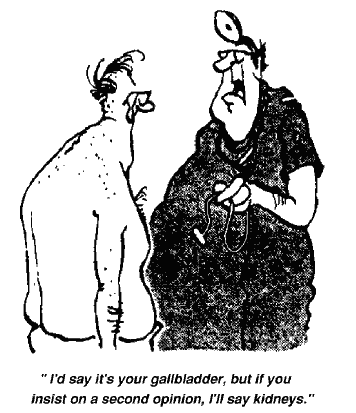
Get a Second Publishing Opinion


To Whom It May Concern~

Thank you for submitting your manuscript to Rejection Publishing. We regret to inform you that we cannot publish your work at this time... blah..blah..blah.

Shot down? You may as well have had someone tell you in no uncertain terms that you are a worthless, good for nothing, failure. You are not even worthy of the paper it took to print your "masterpiece."

Do not buy into the "lie."  Your blood, sweat and tears deserve a second chance. Or a third, forth or even a dozen. Just ask J.K. Rowling, or Stephen King. Rejected dozens of times by major publishers, these success stories represent many a hard climb to the top.

Publishing companies have many different reasons for rejection. For one thing, your script has to get into the hands of the right person.  Assuming that happens, obvious reasons why you will not get past "first base" are simple things like spelling errors. Even if your book is great, you will not get far with such basic oversights. A great tip so as not to waste either your time or the publishers is to check and make certain that your work appeals to the market to which they cater. A little bit of research will confirm this.

So after making sure that your basics are covered and that your story is unique and ready to convince publishers that it is a moneymaker, there is no reason not to be confident in what you have.

Remember, if at first you don't succeed, then submit, and submit again! If you get fed up and want to consider self-publishing, I can show you the ropes.

Need help with writing, editing, publishing, or book marketing? thepublishingguru(at)gmail.com

Saturday, August 25, 2012

50 Shades of Inspiration


Photo by Adrian Midgley

Erika Mitchell, better known as E.L. James, has had remarkable success with her self-published novel, 50 Shades of Grey.  Most of my clients and social media friends know I don’t promote erotica, however, there are many lessons that her success offers. While I have researched this book as a publishing case study, I didn’t read the book, nor do I endorse it.

The top five things that 50 Shades teaches indie authors are:

1.       Use familiar characters50 Shades started out as a fan fiction series, Master of the Universe. Mitchell refined it and created an original novel.  Her characters are based on very successful characters from Twilight, most notably Bella and Edward reworked as Anastasia and Christian, with other hints of Bella’s mother and Jacob thrown into the mix through other characters.  I am not suggesting stealing characters directly from other works. Identify what people like about the character archetypes in successful novels; use what works about them, leave out what doesn’t, and add your own signature touch through new characteristics. 

Characters can drive reader interest even more so than plot, therefore analyzing what the public likes about iconic characters can be a great way to come up with characters that work for you.  If you decide to create a series the way that J.K. Rowling, E.L. James, Suzanne Collins, and Stephenie Meyer did, you have to start with great characters.  The plot will change and the characters will develop throughout the duration of the series, and following the characters is often what motivates readers to purchase the next installment.

2.      Use passion and fantasy.  Whether it is the dismal economy or a certain dissatisfaction with modern life, fantasy sells.  Harry Potter, Twilight, 50 Shades, and The Hunger Games all incorporate some kind of fantasy and offer a departure from reality for readers, which is, after all, the point of fiction.  This is not to say that you can’t make money with a book that is not in the fantasy genre; 50 Shades is only fantasy insofar as it explores sexual fantasies.  Bring passion, fantasy, and imagination to everyday, ordinary scenes and people, whether it’s in the form of an over-the-top character, a character with the kind of quick wit that only exists in fiction, or a character who does extraordinary things, even if he/she is just an average mortal.

3.      Push the envelope.  Don’t include gratuitous sex and violence in your stories to capitalize on sensationalism, but consider what edgy content would be appropriate for your story.  A portion of the success of 50 Shades can be attributed to the curiosity factor.  If you’re concerned that people might be offended by the content of your book, you can hold yourself back from succeeding by giving readers a product that insults their intelligence by watering down incidents, dialogue, and subcultures.

4.      Don’t let your day job or your age hold you back.  E.L. James is a 49-year-old woman who leads a modest life as a wife and a mother.  As a former television executive, her background is not one that is related to books, literature, or writing.  No one is more surprised by the success of the novel than James herself, who typed 50 Shades on her Blackberry during her commute to work.

Although you shouldn’t break driving laws to write your book, James’ story shows that no matter how busy you are, there is time that could be spent writing your book.  She also shows that starting late in life after leading a fairly normal, less-than-notable lifestyle in an ordinary job does not disqualify you from becoming an author.  There is no reason to allow your age, job, background, or time schedule to hold you back from writing the next bestseller.

5.      Get involved with your research.  James’ husband, Niall Leonard, has famously complained about growing tired of the “experimentalism” that she used for her research.  Although James’ research is far different from the kind of research that you might do for your own book, she proved one thing without a doubt: no amount of reading and fact-finding can compare to first-hand research.  James’ book resonates with readers because she lived her book and what her characters would have gone through, enabling her to write 50 Shades in a compelling, realistic, relatable, and accessible manner. 

If you’re writing a book about someone on safari, go on a safari yourself, rather than reading about people who did.  If you’re writing a book about New York high society, visit the famed watering holes and restaurants yourself so that you can describe the ambience and total sensory experience in exact detail, rather than relying on the Zagat guide for insight into the world in which your characters exist.

James is not the first self-published author to experience tremendous success, nor will she be the last.  By analyzing what made James a success and how to make it work for you, your book may be the next international sensation.

Thursday, August 16, 2012

Military Writers Society of America Announces 2012 Award Nominees


Military Writers Society of America (MWSA) Honors 80 authors with Award Nominations ranging from the President’s Award, the Founder’s Award, Author of the Year and 25 other categories from Fiction, Nonfiction, Children’s Books, and Poetry. MWSA President, Joyce Faulkner and 2011 Recipients will present awards to the nominees and winners at the MWSA annual conference in Dayton, Ohio, September 27 – 30.

Pittsburgh, PA  -- The Military Writers Society of America (MWSA) announced the nominees for its prestigious Gold, Silver and Bronze Awards, President’s Award, Founder’s Award and 2012 Author of the Year. MWSA Vice President Mike Mullins announced the nominees at 9:00 am (EST), Saturday, July 28, on Veterans Radio Network show,” At Ease” hosted by Dwight Zimmerman. Veterans Radio (http://www.veteransradio.net)  is dedicated to the men and women who served, or who are now serving, in the USA armed forces.

MWSA President, Joyce Faulkner, and the 2011 award recipients will present the awards at the annual MWSA conference banquet and awards ceremony, September 27 – 30 in Dayton, Ohio at the Holiday Inn Dayton/Fairborn. Award-winning author Del Staecker will emcee the award ceremony and present the awards. The 70 award nominees are candidates for Gold, Silver or Bronze Awards with first and second honorable mentions in 25 different categories. Jack Woodville London, 2011 Author of the Year will present the prestigious 2012 award to one of three nominated authors: William C. Hammond, Mike Angley, or Carolyn Schriber

Nominees represent the highest scoring reviews from the hundreds of books submitted this year from the authors and publishers. Mrs. Faulkner states, “These award nominees are already winners. Some of the benefits of their being nominated include appearances on various blogs and radio talk shows, features on MWSA’s website and monthly Dispatches magazine, and interviews on radio and public-access television during the annual conference in Dayton.”

All 2012 award winners and nominees participate in MWSA’s fall conference, which will feature in a pre-conference event, Writing Workshops for Veterans, Emergency Care Providers and their family members, presented by Leila Levinson, September 27, 2012 at the Holiday Inn Dayton/Fairborn, Fairborn, Ohio. Instructors for the workshops are Veterans and children of veterans who have used writing to come to terms with their own trauma or the legacy of trauma within their families.

About Military Writers Society of America
The Military Writers Society of America was the brainchild of Founder, W. H. (Bill) McDonald Jr.  A crew chief/door-gunner on UH-1D Huey helicopters in 1966 and 1967, Bill flew with the 128th Helicopter Assault Company out of Phu Loi, South Vietnam. He was awarded numerous medals, including: the Distinguished Flying Cross, the Bronze Star, fourteen Air Medals and the Purple Heart.

To better understand his own experiences, Bill began to write about them. In the years since, he has discovered literally hundreds of other warriors who are driven to explore and reveal their experiences through fiction, non-fiction, poetry and art. It was Bill's vision to bring them together to share and promote their respective arts.

Joyce Faulkner is the current President of the organization. She states, “Military Writers Society of America helps veterans, their families, and historians record history and the complexities of military life―and encourages writing and other creative endeavors as therapy for the stresses of our special circumstances. We focus on using these works to educate the general public, students, and the military community.”

For additional information or to schedule an interview with one of the nominees contact:  
Joyce Faulkner, MWSA president, Bridgeville, PA (412) 496-5034.

For additional information on the Military Writers Society of America: http://www.militarywriters.com


Contact: Sandy Lawrence
sandylawrence@perceptivemarketing.com

Tuesday, July 3, 2012

Award Winning Publishing, Now Stateside


Award Winning Publishing, Now Stateside
BrightRED Publishing appoints Parkwest Publications to distribute best-selling educational line for High School students

Well-known since 1983 for the North American distribution of general interest books of the early days of the BBC in America as well as middle school hands-on educational books from award-winning Tarquin Publications… Parkwest is excited to announce that they’re doing the same for the hugely successful line of educational books from BrightRED Publishing, Edinburgh, Scotland. Parkwest and BrightRED have teamed up to bring to US and Canadian high schools and students this range of popular, superbly designed, and most important, effective educational titles from a new star in the UK’s publishing firmament – BrightRED Publishing.

BrightRED, though a young company, has already won the UK Independent Publishers Association’s  award for the Educational Publisher of the Year two years in a row (2010 and 2011).  Formed in 2008 by Sarah Mitchell, Richard Bass, John MacPherson and Alan Grierson, BrightRED’s titles target students in high school with books that are in full-color, are bright, accessible and easy to use and cover the complete course.  Quite simply they help high school students of all abilities to know their subject and achieve better marks  in their exams.


BrightRED brings their passion stateside… to inspire young minds to think creatively and achieve their full potential. BrightRED has excited the publishing world with their impressive business acumen, dedication to bringing high-quality educational titles to children, and the drive to be the best in their business.  

Parkwest’s well known and trusted distribution of quality UK books has built an impressive reputation in the US market which will benefit even more with this new and exciting partnership with BrightRED.


American and Canadian high school students, parents and teachers will be thrilled by the possibilities for solid achievement with these BrightRED books.  


 Learn about BrightRED and Parkwest by visiting

Friday, June 15, 2012

A Survivor Learning to Thrive

The Call

Bay Area author Derald Hamilton calls himself “a survivor learning to thrive.”  Hamilton’s life experiences lend themselves to his stories, giving them humor and insight.  The master storyteller offers readers something our generation does not often see: truly literary work that combines unforgettable characters with resonant thematic elements.

As a young man, Hamilton received what he believed to be a call to the ministry; after working to save for seminary, his studies and experiences at Phillips Graduate Theological Seminary left him disillusioned, believing the church to be a “hotbed of politics and competitive showmanship.”  In The Call, a coming of age story circa the generation of the 1960s and 1970s, Hamilton uses his own experiences to write the fictionalized account of a young man, Ishmael O’Donnell, pursuing his own calling to the ministry.  Hamilton blends satire and the supernatural in his “humorous but disturbing” account of divinity school and the people who are drawn to answer “the call.”  The Call chronicles the events leading up to Ishmael’s entry into seminary and his quest, once there, to obtain the key to his purification.

Twice Upon a Prequel and Three Shorts is an anthology comprised of two novellas, The Astonishing Elmo Piggins and The Rebirth of Reginald Dexter, and three short stories: “Taken Up Before the General,” “The War Comes Home,” and “A Litter Bit of Wisdom.”  The Astonishing Elmo Piggins is a story of drugs, sex, rock ‘n roll, and religion in 1960s and 1970s Southern culture, and The Rebirth of Reginald Dexter is a story of reinvention and self-affirmation.

His stories offer the important themes that life begins where you are, that the social order will attempt to suppress anyone who tries to be his/her own person, and that, for better or worse, life happens, among other lessons.  For anyone who has ever questioned authority, been subject to authoritarian powers, or sought freedom from bondage, the characters and events portrayed in his novels are certain to hold appeal.

For more information about Derald Hamilton, please visit www.dhamiltonbooks.com or like him on Facebook at www.facebook.com/communitystandards#/profile.phP?id=100002

Monday, April 30, 2012

Two Roads Diverged: Understanding Traditional and Self-Publishing Differences


Photo by Fergal Claddagh


The publishing world has experienced change over the past several decades as all industries have, but the next 10 years will be a cocoon altering it into a different species altogether. Many major print publishing houses have either merged, or acquired smaller houses, and the net result is that there are fewer traditional channels for getting your book published. However, this only means that the nature of the challenge of getting a book published has changed. It does not mean that the challenge has become insurmountable.

The traditional publishing path of the past has been described similarly by many sources. Write a book, send query letter and/or book proposal to agents, get picked up by an agent, get sold by agent to a small-to-medium-size publisher, pray that your book takes off and garners attention from a big publisher who pays you a six-figure advance in return for the rights to your book.

Nathan Bransford, a literary agent with Curtis Brown, discusses going from small presses to big publishers. I agree with many of his points on the difficulties of being recognized by a big publisher. His advice is very similar to my premise, if your book is really good, well edited, designed, printed, distributed, and promoted, it will succeed.

Today, the traditional publishing path is in upheaval and turmoil. The economic downturn has caused many small publishers to shut their doors or, at best, significantly decrease their new release budgets. The emergence of the Kindle, Nook, and other Ebook readers has stirred things up. Publishers of all sizes are more carefully scrutinizing new authors, primarily seeking to invest in less-risky authors with established platforms. Gone are the days of a publisher investing marketing dollars to help an author develop their platform.

The new traditional publishing path is emerging as more of a partnership between author and publisher with the responsibility for marketing and publicity resting on the shoulders of authors. If you bring a viable manuscript to the table with a sound marketing plan and/or platform, the publisher will invest in editing, design, printing, and distribution, the rest is up to you.

The exciting game-changer for the unknown author is the advent of affordable self-publishing options. Self-Publishing should not be confused with the deplorable practice of Vanity Publishing where an author is charged seriously inflated prices for editing, design, printing, and/or marketing services while giving up 80% or more of profit and/or rights to their material. True self-publishing is where the author handles editing, design, printing, distribution, and marketing for their book or hires professionals to assist with the process while experiencing control, speed to market, ownership of rights, and max profitability.

The self-publishing path has existed since the dawn of time. Dan Poynter lists 155 best-selling books that started out being self-published. In the past, the editing, design, and printing of a book could easily run $15,000 or more because of minimum print runs of 5000 being required. With the advent of print-on-demand merged with distribution channels, the cost of the entry toll on the path of self-publishing has diminished significantly. And publishing a Kindle version of your book doesn’t require an investment of money whatsoever.

I’m not preaching against the traditional publishing model. I cut my teeth in traditional publishing. My family was in the traditional publishing business for nearly 25 years. I started at the bottom in the warehouse of a traditional publisher picking and packing orders. I eventually worked my way up to running a subsidiary of this same publisher. Throughout my career, I kept seeing countless numbers of authors turned down because we simply didn’t have the budget to add them to our production schedule. I have studied the self-publishing industry in great detail. I became passionate about being a part of an author-empowering movement to publish and promote quality books that otherwise may have been unrecognized without modern advances in the self-publishing industry.

The old-school mindset that says to avoid the stigma of self-publishing is quickly becoming a whisper in the wind. More unknown authors are starting out self-published for the first time in history. I believe self-publishing is the democratization of the publishing industry. Any unknown author now has a chance.

In my seminars and workshops, I tell authors to treat their book like a business. If you want a real chance, you must treat your book like a big publisher would. When naysayers point to the statistics that say self-published books average less than 200 units sold, I can rebut with a missing link in the formula and Poytner’s list. Remember, if your book is really good, well edited, designed, printed, distributed, and promoted, it will succeed, regardless of the road taken in the yellow wood of publishing.

If you need help with writing, editing, publishing, or book marketing, email me: thepublishingguru(at)gmail.com

Tuesday, April 24, 2012

What in the World do I do with this Manuscript?


Once you’ve put in the necessary time it takes to complete your book, you have your manuscript. You may be feeling like you’ve actually given birth at this point. There’s a big difference between reading about this process, and experiencing it. All of the creativity, focus, and work that go into completing a book are something to be celebrated. In fact, you have reached a wonderful milestone in your writing career.

A completed manuscript will ultimately take on various forms, even after it is finished. After the editing and proofreading process, manuscripts often look different from their original form. These two processes are completely necessary to get your book into a marketable form.

Some writers are very proficient in the editing process and are capable of editing their own work. This means, they will go through their manuscript searching for grammatical and spelling errors. They will also proofread their book for construction problems. But overall, it is common for writers to get assistance with editing and proofreading.

Fortunately, there are various literary companies that offer these services. They will not only give your manuscript grammatical attention, but they will also look for other issues. Minor problems with grammar can typically be corrected easily. In fact, most writing programs come with their own correction modules.

Although these issues can be fixed quickly and easily, they are important problems to focus on. When a book has too many issues with grammar, it becomes difficult to read. Anything that takes away from the information in your book hurts the impression of your work. This is why these types of corrections are crucial.

Correcting construction problems is also a service that literary companies perform for writers. With this service, editors will look for story line problems. This can come in the form of sentence or paragraph structure. It can also be an issue of character or topical information. Most of the companies, which do this type of work, will also provide advice for writers.

This often comes in the form of a detailed analysis, showing which corrections need to be made. You will be very pleased once you’ve incorporated the necessary changes in your manuscript. Once these have been done, you will have a finished product that will allow you to look at your different publishing options.

These options are various, but all rely upon your book being in the best final form possible. There are three publishing choices that are the most popular for first time authors. The first is to publish through a traditional publishing house. There are large and small publishing companies that are sometimes looking for new authors to publish. If you want to pursue this option, you will need to find an agent.

There are some publishing companies that are co-publishers. These are companies that split the cost and profit on publishing your book with you. The third option is self publishing.

In recent years, many authors have taken advantage of the self publishing option. There are also many companies that allow authors the opportunity to do things like cover design, font choice, and other marketing. Researching each of these will be paramount to finding which is right for you.

Need help? thepublishingguru(at)gmail.com

Monday, January 9, 2012

Moving Beyond Aspiring Author


Unemployed, a single mother and frankly, just plain ordinary, J.K. Rowling's outlook on life was dim at best. So, how did she go from the depths of despair to the life of a billionaire?

She took an "idea" about which she was enthusiastic and started crafting it into a manuscript, one word at time. That’s it. Magic and wizardry she did not possess, inside connections she did not have. The dedication to bring to life that which would otherwise haunt her until it was produced is how she arrived.

So many of us aspire to be writers, we have loved it, lived it, tried it, failed at it and mostly wondered about those who had achieved writing success, "How did they do it?" There is no textbook way of getting there. No "10 steps to arriving."  That would be too easy, and besides, the art and spontaneity would be lost.  

If those we admire most in the field were asked, "How did you do it?"  The resounding consensus would most likely be the same.., "We did not quit." "We did not let someone tell us we were not good enough."  "We re-submitted again and again." Rowling's first rejection letter came back as quickly as they had received her manuscript. Had she let that phase her, she still may be a teacher and living hand to mouth.

Believing in yourself and never giving up sounds cliché, and working when you have no hours left in the day sounds unfeasible. But deciding that you can conquer those will be the difference from "aspiring" to "arriving."

Need help with writing, editing, publishing, or book marketing? thepublishingguru(at)gmail.com

Monday, December 26, 2011

What is Real Author Success and Can You Find It?


http://www.flickr.com/photos/kevint/
Guest post by Deborah Riley-Magnus

Author success can mean different things to each author. Some are thrilled to have penned 50,000 words in a limited amount of time. Many imagine that signing with a literary agent or publisher is author success. And still others feel that holding a book emblazoned with their name is author success. I’m proposing that REAL AUTHOR SUCCESS is something slightly different. Real author success is what happens after the book is out there and gauged by how it’s received … because these days, making your book a sales success is all on your shoulders.

The difficulties and struggles authors face in today’s publishing industry twists and turns can sometimes feel like a crazy hurricane but there’s no need. Real author success is within every author’s reach and far simpler than you think.

Come closer, let me whisper this big secret …

  • The answers are all hidden right inside your manuscript
  • And the implementation of great marketing, promotion and publicity is as much creative fun as it was to write your book.

See, the common concept of author marketing and promotion falls under the “same-old-same-old” theory. If all the other authors are pricing their ebooks at $0.99, you do it too. If they’re giving away books, so do you. If twitter authors are posting their book videos, you need a book video so you can post it as well. And if facebook has become a place for authors to show off their marketing strategies to each other (and notice … often this showing off is to other authors and seldom to prospective book buyers), you need to hook up with those authors too because of course, you need to do those strategies too.

Please understand, I don’t think any of these things are bad. The only problem is that now everyone is doing the same thing and to me, it starts to sound like a lot of noise

I have a suggestion. If an author looks carefully into their own manuscript and discovers the unique marketing approaches right where they wrote them, no other author can copy them. What a way to stand out. It’s so hush-hush.

All right, it’s not such a big secret, but have you noticed that very few authors actually look for unique ways to market and promote? It’s not difficult at all but it does take a little time to seriously strategize marketing and promotions that are built for powerful impact. It’s easier to do what everyone else is doing.

May I ask a question? Did you write your book like everyone else does? Did you copy their characters, plots or literary voice? Of course not. So why drop the ball at the most important juncture of your career? Why forget to be creative, original and powerful with your marketing? Your book deserves at least that much.

Standing apart isn’t standing alone, it’s all about SHOUTING YOUR UNIQUE MESSAGE and it’s the most basic of all marketing techniques. Everything that makes you and your book special is inside your manuscript. If there are a thousand mystery authors out there doing free giveaways, low pricing and silly contests, and you are announcing not only a different message but to a different – more targeted - audience, it can only result in book sales. For example …

Let’s say your book takes place on the New England coast. The murder occurs in the late 1800s and the story unfolds when a lovely woman discovers the body of a long-missing sea captain in a lighthouse. You can simply shout out the title of your book to every twitter and facebook listener you can reach. You can post your book cover everywhere and make a book video and tell all your friends and followers. It’s what every other author does and yes, you should do that.

BUT … you can go a lot further. Here are a few ideas.

  • Hold speaking engagements/book signing events in lighthouses
  • Request that lighthouse gift shops all over the east and west coast carry a few copies of your book on their shelves
  • Locate historical lighthouse groups online and join … talk lighthouses and make sure your book is prominently displayed on all your emails
  • Donate a portion of your sales to lighthouse restoration organizations, and ask if they’ll permit you to post your book cover and purchase link on their website or in their newsletter
  • Blog about the things lighthouse lovers might be interested in
  • Become an expert on lighthouses and the era so you can blog or speak on the subject to anyone interested in historic mysteries
  • And finally, remember, there are LOTS of mystery lovers who aren’t members of the mystery readers book clubs you find online. Take a leap and ask nurses groups, gardening groups, needlepoint groups, even antique lovers groups if they’d be interested in having you come speak about your book at one of their meetings. Trust me, these folks are always looking for interesting subject matter to offer their members.

Okay, so there are no lighthouses or dead bodies in your book. If your book has a major event or most scenes taking place in a coffee shop or Italian restaurant or at a truck shop or on a dude ranch, there’s no reason you can’t dig as deep and find between five and ten new target book buyer groups. It’s the road less traveled and there are LOTS of prospective fans on that road.

All of this can be fun, it’s definitely creative, and above all, not crowded with a million other authors trying to get your book buyer’s attention. And the best part … it’s completely unique to the book you wrote.

How’s that for Real Author Success! To help get you started, I’d like to offer you a FREE 10 Tools for Author Success PDF handbook. Just go to http://theauthorsuccesscoach.com/ and click on the downloadable link.

I’m also offering a free ebook copy of my book, Finding Author Success – the winner will be drawn from those who comment on this blog.

ABOUT THE BOOK
Finding Author Success: Discovering and Uncovering the Marketing Power Within Your Manuscript.  

Even the odds for authors with this one-of-a-kind guide to marketing success! Deborah Riley-Magnus takes tried and true marketing, publicity and promotional strategies and tailors them for the unique needs of today’s author. Every element is outlined and explained for easy implementation. You will learn:

  • How to develop a functional and strong book business plan
  • The power of developing effective, targeted platforms
  • The basics of publicity, marketing and promotion
  • How cross marketing works and why it’s magic for an author
  • How to personalize it all to your book

Finding Author Success will take away the mystery about gaining sales and increasing exposure for your book and you as a professional author.

A portion of “Finding Author Success” sales is donated to the American Literacy Council. The American Literacy Council’s main purpose is to convey information on new solutions, innovative technologies, and tools for engaging more boldly in the battle for literacy.

ABOUT THE AUTHOR
Deborah Riley-Magnus is an author and an Author Success Coach. She has a twenty-seven year professional background in marketing, advertising and public relations as a writer for print, television and radio. As an Author Success Coach she focuses exclusively on publicity, marketing and promotional solutions for authors.

Deborah produces several pieces weekly for various blogs and websites including her author website and Unruly Guides, and an author industry blog, Deborah Riley-Magnus,Writaholic. She teaches online and live workshops as an Author Success Coach. In January of 2012, she will be launching a new online publication called the Whispers of the Muse Literary Magazine.

A native of Pittsburgh, Pennsylvania, she has lived on both the east and west coast of the United States and has traveled the country widely.


LINKS
Finding Author Success: Discovering and Uncovering the Marketing Power
Within Your Manuscript

Amazon Kindle
http://www.amazon.com/Finding-Author-Success-Discovering-ebook/dp/B0061NW5BC/ref=sr_1_3?s=books&ie=UTF8&qid=1320173201&sr=1-3
 
Amazon Paper
http://www.amazon.com/Finding-Author-Success-Deborah-Riley-Magnus/dp/1926760662/ref=sr_1_4?s=books&ie=UTF8&qid=1320173201&sr=1-4
 
B&N Paper and ebook
http://www.barnesandnoble.com/w/finding-author-success-deborah-riley-magnus/1106661344?ean=9781926760667&itm=1&usri=finding%2bauthors%2bsuccess
 
APPLE
http://itunes.apple.com/us/book/finding-author-success/id473774819?mt=11&ign-mpt=uo%3D4
 
SONY
http://ebookstore.sony.com/ebook/deborah-riley-magnus/finding-author-success/_/R-400000000000000525040

DEBORAH RILEY-MAGNUS LINKS
I blog - http://rileymagnus.wordpress.com/
I teach -
http://theauthorsuccesscoach.com/
I fiction –
http://coldincalifornia.com
I write -
http://deborahriley-magnus.com/
I tweet –
http://twitter.com/rileymagnus
I facebook -
http://www.facebook.com/deborah.rileymagnus
I should be sooo tired!

Note: Sometimes free article writing services can be helpful to spur inspiration when faced with the occasional yet inevitable writer's block.

Tuesday, May 24, 2011

10 Things You Need to Know About Self-Publishing


This guest post is brought to you by Web Design Schools Guide.

Today’s authors have started to catch on to the fact that they no longer have to depend on and pay a third-party publisher to do the work that they can do themselves by self-publishing. Self-publishing is no piece of cake, but these books have all the potential to be best sellers and major moneymakers just like their commercially-published counterparts. Whether you’re sold on having endless artistic freedom or complete control over your work, self-publishing is a rewarding task and terrific option for authors who are willing to put in the extra effort. Here are 10 things you need to know about self-publishing:

  1. You Need to Pick a Niche: It’s important to pick a well-defined niche for your book to guide you during the writing process and help determine your target audience. Niche books tend to do best, so it’s generally a good idea to write what about what you know and steer away from personal journals, emotional rants or niche topics that no one has heard of. Also, think about what your audience wants to read and what’s missing from your chosen niche. Once you determine this important information, you can better address the needs of your readers and niche market, as well as make a name for yourself.
  2. Study Your Competition: Before you self-publish, it’s important to study, analyze and keep up with your competition. If you haven’t picked a niche for your book yet, but have a couple genres in mind, start your investigation by looking closely at these types of books and authors to compare and contrast. If you do your homework and stay on top of your competitors’ latest works, you’ll be able to bring something fresh and new to the table and hopefully stand out from the others.
  3. You Are Your Own Editor: It’s important to remember that self-published authors are on their own for editing, unless you hire a professional editor, which can get expensive, fast. Proofreading and revising your own work is all part of the self-publishing process and is necessary to maintain full creative control of your book. If you’re taking the self-editing challenge, be sure to utilize the numerous editing resources available online, and try to get a second set of eyes to take a look.
  4. Make Your Title Memorable: In order to stand out among the rest, you’ve got to make your book title unique and memorable. This is true for any book – self-published or not. A short, clever title is always preferable, but it should still be clear and relevant to your book.
  5. Self-Publishing Includes Self-Promotion: If you don’t have a publishing company and literary agent to market your book for you, you’d better be ready to do it yourself. Self-published authors have to put themselves out there and take an aggressive approach to marketing if they actually want to sell their books. This includes promoting the book online, organizing book signings and sending complimentary review copies to newspapers and magazines. Essentially, you should eat, sleep and breathe your book so others will care about it as much as you.
  6. Praise and Criticism Should Happen Naturally: As tempting as it is to ask friends and family to write positive reviews for you, whether they’ve read your book or not, authors should overcome this urge and let praise and criticism happen naturally. Fake or forced reviews are easy to spot, and it won’t help your image one bit. So, sit back and let unbiased readers praise your work or rip it to shreds. After all, isn’t criticism better than no attention at all?
  7. A Literary Agent Isn’t Necessary: As much help as literary agents can be, they aren’t necessary for selling good books. If you’re dead set on self-publishing and reaping the benefits on your own, you probably don’t have much need or desire for a literary agent who works in mainstream publishing. Having an agent often defeats the purpose and personal benefits of self-publishing because you’ll no longer have 100 percent control over your work.
  8. Self-Published Authors Can Still Win Awards: Forget what you’ve heard before – self-published authors can win awards too! Every year, there are several writing contests to enter and awards to be given for superb self-published work, including short stories, fiction, nonfiction, poetry and many other genres. Credibility, a strong readership and strategic marketing will help you achieve your goals and reach the award-winning level.
  9. Know Your Audience: An essential part of writing and successful self-publishing is knowing your audience. Since self-published books generally cater to a smaller niche market, you have to consider your audience from the project’s conception, publication and marketing stages. One way of knowing your audience is to study the demographics, interests and needs of readers within your chosen niche. If you’ve self-published work in the past, get in touch with your readers and deeply consider their comments, concerns and questions when writing your new book.
  10. Send Out Review Copies: One of the best ways to establish credibility and garner attention for your hard work is to send out review copies to as many people and publications as possible. If your budget allows it, you can snail mail printed complimentary review copies of your book to newspaper, magazine and journal reviewers, as well as publishing companies, bookstores and anyone who sparks an interest in your writing.

Need help with writing, editing, publishing, or book marketing?  thepublishingguru(at)gmail.com

Monday, December 20, 2010

5 Attributes of a Title That Sells


Photo by azrasta via Flickr


An innovative book title should be distinctive and hook the reader. It is what makes a shopper grab your book from the shelf and open it to the inside flap to learn more. The jacket cover can finish the job of convincing him/her that your story is worth reading. Your job is to create a title that grabs the attention of the reader. Here are five things to consider when naming your book:


Catchy--Your book title should be catchy. A potential reader will often spend only 5 minutes in a bookstore grabbing a book on his/her lunch break, or on the way to catch a flight. An author needs to work hard to make the 30 seconds spent looking at the book’s cover turn into the decision to buy that book.


Fitting--Your book title should fit the book. It should give the potential reader a clue about what the book will be about.


Brief--Your book title should convey a message, but not be too long as to bore potential readers. They should be able to read your title at a glance, requiring no time at all for it to register with the brain. The DaVinci Code is a good example of a short title. Brevity is a virtue.


Compelling--Your book title should captivate the potential reader, initiating a response of interest and curiosity. Find intriguing aspects of your story that your readers can visualize, and then use those words in the title.


Unique--Try to make your title different from others. Do a quick search online to make sure that the title you are considering hasn’t been used before. Global Books in Print is an excellent bibliographic tool with millions of titles in its database. The more unique the title, the more it will stand out from the rest.


Don’t ever hesitate to rely on the expertise and editorial changes of your editor or publisher. They are your best resource when it comes to marketing and publishing.  Although creating the most marketable title definitely takes some work, having the right title can make a world of difference when it comes to book sales—because people DO in fact judge a book by its cover!

Wednesday, September 22, 2010

Do You Have a Good Negritude?


Today, I was introduced to a new word by the TrueTwit Validation Service.  It was one of the words I had to type to validate that I was a human.

Negritude (an ideological position that holds Black culture to be independent and valid on its own terms; an affirmation of the African cultural heritage)


It was coincidental for me.  I happen to be in the middle of publishing a book with the title The Blended Church: The Emergence of Multicultural Christianity.  The author, Dehner Maurer, states there is one place in the United States that racism is more prevalent than any other - the church.

Here is a little sneak peek from the foreword by Dr. Myles Munroe.

"Martin Luther King, Jr. expressed his dream 'that one day on the red hills of Georgia, the sons of former slaves and the sons of former slave owners will be able to sit down together at the table of brotherhood,' and that his 'four little children will one day live in a nation where they will not be judged by the color of their skin but by the content of their character.'

Almost 50 years have passed since Dr. King spoke those words in the midst of a struggle to build bridges between races, and an honest examination will reveal that the yearning he expressed is still not fulfilled in our culture, especially in the church.  Tremendous advances have been made in race relations, to the extent that America’s first Black president occupies the Oval Office.  Minorities have moved past the doors of schools and executive offices of corporations.  The ethnic complexion of suburban neighborhoods has changed, but the congregations at a typical Sunday church service remain basically the same.  In addition to identifying churches as Baptist, Methodist and otherwise, we still describe them as 'white' or 'black.'

 In a first century world characterized by bitter racial, cultural, national and social hatred, the Christian church was a model of reconciliation and harmony.   Speaking of Christ and the church, the apostle Paul wrote: “For he himself is our peace, who has made the two one and has destroyed the barrier, the dividing wall of hostility . . . His purpose was to create in himself one new man out of the two, thus making peace, and in this one body to reconcile both of them to God through the cross, by which he put to death their hostility” (Eph. 2:14-16 NIV).

In this book Dehner Maurer presents a thorough and revealing analysis of the church’s failure to fulfill its divinely appointed purpose regarding racial harmony and prescribes practical and biblical principles to meet the problem.  He shows that true reconciliation goes beyond token integration and statements of equality to a spirit of unity and purpose.  Such a spirit begins in one-on-one relationships in which we view the other person as someone whom God loves dearly and for whom Christ died. Maurer enforces the principles he espouses with both biblical and contemporary illustrations, primarily from his own church situation.

People in pews and pulpits of all churches and races will profit from reading this book and implementing its teachings."
Your thoughts?


Who links to my website?